Maui Council passes vacation rental phase-out bill on first reading with 5-3 vote
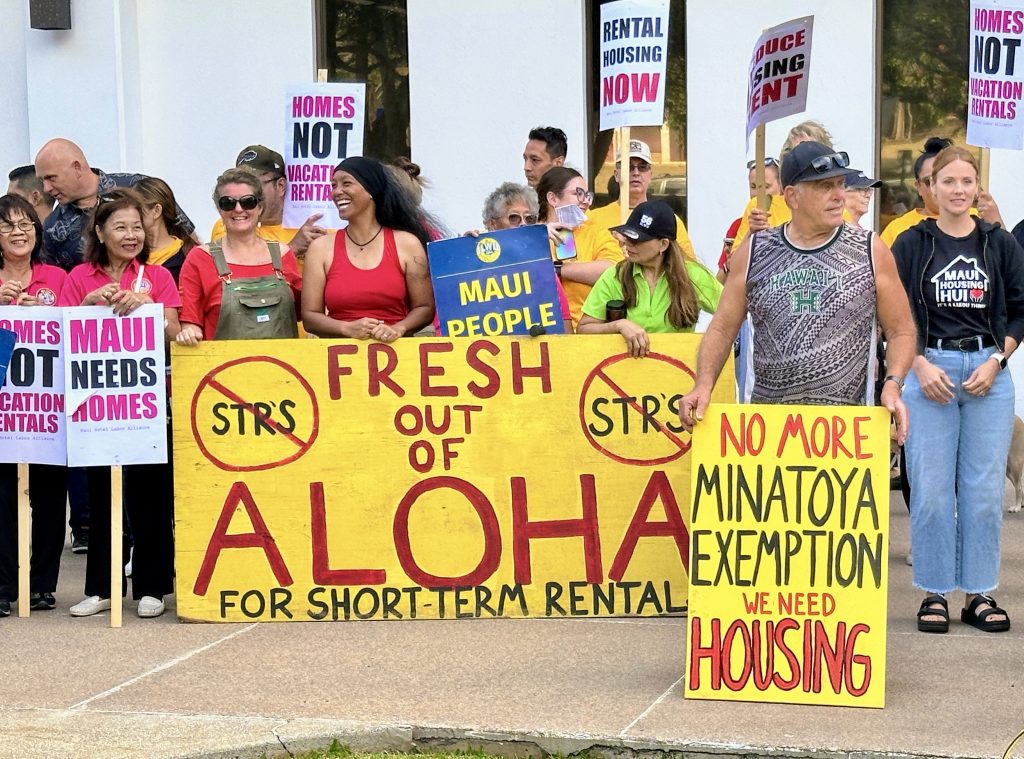
The Maui County Council passed the contentious Bill 9 on first reading Monday, advancing a measure that would phase out thousands of transient vacation rentals currently operating in apartment-zoned districts, mostly in South and West Maui.
The measure passed by a vote of 5-3 following a daylong meeting that included hours of emotional public testimony and council members’ deliberations over proposed amendments.
Voting in favor of the bill were Council Members Nohelani Uʻu-Hodgins, Tamara Paltin, Keani Rawlins-Fernandez, Shane Sinenci and Gabe Johnson. Voting in opposition were Council Chair Alice Lee, Vice Chair Yuki Lei Sugimura and Council Member Tom Cook.
The bill aims to convert approximately 7,000 units—many currently on the so-called Minatoya list—from short-term vacation use to long-term residential housing.
The proposal comes as the island continues to grapple with a severe housing shortage aggravated by the August 2023 wildfires that destroyed more than 2,200 structures.
Debating the impact
Supporters argued that the tourism economy has become extractive and that the housing crisis requires intervention to prioritize local families over visitor spending profits.
“Some people see Maui as a business and some people see Maui as our home,” Rawlins-Fernandez said. “Unchecked extractive capitalism is an Ouroboros. It’s a snake that’ll eat itself if it’s not stopped.”
Paltin reflected on the changes in tourism over the decades and the impact of online booking platforms on residential neighborhoods.
“If too much is never enough, then just enough should be more than enough,” Paltin said.
Johnson pushed back against economic doom-and-gloom predictions, citing recent spending data.
“I don’t want to operate from a position of scarcity,” Johnson said. “I think that our community is smart, adaptable and resilient, and we can come up with a better plan than what we have on the table.”
Opponents on the Council and in the public warned of severe economic fallout, including a projected loss of tens of millions of dollars in annual tax revenue.
Sugimura cited administration figures projecting a $61 million annual loss in real property tax and an additional $15 million loss in general excise and transient accommodations taxes.
“The long-term impact will be to services such as police, fire, the things that we need now for our healthy economy,” Sugimura said.
Explaining her “no” vote, Lee criticized the process used to develop the legislation.
“I’ve been in this business over 26 years, and honestly, this is one of the worst bills I’ve ever seen, structurally,” Lee said. “And the way it has been handled in a sort of backwards fashion. In other words, you come up with the bill, and then you rationalize it later, you justify it later as you go along.”
Amendments and legal risks
Prior to the final vote, the Council debated several amendments. An attempt by Cook to incorporate recommendations from the Temporary Investigative Group, or TIG, failed in a 4-4 tie.
The amendment would have delayed the phase-out for specific properties identified by the group as physically unsuited for long-term residential use.
“This amendment provides a compromise for the implementation of Bill 9, while allowing for the commencement of others’ amortization period,” Cook said.
However, Rawlins-Fernandez argued the amendment would violate state statutes requiring a set “reasonable period of time” for amortization. Attorneys from the Department of the Corporation Counsel further advised that carving out exceptions could weaken the county’s legal defense against anticipated lawsuits.
The Council approved an amendment proposed by Cook requiring the Department of Finance to report annually on the real property tax classification of affected parcels through 2030.
They also passed amendments by U’u-Hodgins to move the deadline for issuing notices to property owners from Jan. 1 to March 1, 2026.
Legal challenges to the measure are anticipated. Former state attorney general David Louie, now a Honolulu attorney and registered lobbyist for Airbnb, testified that the bill violates property rights.
“It is a violation of the US Constitution and the Hawaiʻi Constitution to take away vested rights without compensation, and that is the problem here,” Louie said. “It creates this gigantic risk. Litigation is likely, and it is likely that the county will lose, and could be on the hook for hundreds of millions or even billions of dollars, well, $1 billion.”
Community divided
During public testimony, the Council faced a sharply divided community. Labor groups, including the International Longshore and Warehouse Union Local 142, supported the measure.
Stephanie Smythe, representing the ILWU, challenged council members to act.
“Many of you came to the ILWU union, and you told us that you supported Bill 9,” Smythe said. “Well, now is the time to pay it forward.”
Tara Rojas told the Council that displacement of Native Hawaiians is a current reality.
“Always, always have to have in mind the crisis of Kanaka Maoli, the people of this place becoming a minority in their own homelands,” Rojas said. “What is Hawaiʻi without Hawaiians?”
Conversely, small business owners and property managers argued the bill would hurt the local residents it intends to help. Leslie Brown, who has run a short-term rental company in Kīhei for 40 years, said the threat of the bill is already causing layoffs.
“The negative publicity from Bill 9 is already having an adverse effect on our economy,” Brown said.
Maui Chamber of Commerce President Pamela Tumpap also warned against taking economic risks without a concrete plan.
“We cannot solve this crisis by deepening the economic crisis, we need a strong economic development plan to come first,” she said.
In response to the vote, Mayor Richard Bissen thanked the Council for advancing the legislation.
“Mahalo to the Council for its critical work in advancing Bill 9 on first reading, a bill that has traveled a long road over the last two years—a reflection of its importance to our community—and my deep gratitude goes to every community member who continues to show up, testify, and share their manaʻo as we look ahead to second and final reading,” Bissen said.
The bill now heads to a second and final reading, scheduled for Dec. 15.
Sponsored Content





Subscribe to our Newsletter
Comments